I'm almost 40, and I've been obsessed with money since before I understood it.
Not obsessed with being rich — obsessed with the mechanics of it. How it grows, why it vanishes, what separates the people who keep it from the people who lose it twice.
I come from a humble house. Six siblings. My parents weren't rich, but they were rich about the things that turned out to matter — they chose happiness and good values over chasing ringgit, and somehow that lesson sits underneath everything on this site.
The kid who sold things
In primary school I was already selling stuff to classmates and squirrelling away the profit. In secondary school I did a bit of everything — part-time work, helping my uncle run his business until it wound down — and it went well enough that I was offered a study sponsorship.
Here's my first honest confession: I was too young to know what to do with it. I was good at studies, so I followed the "good at studies" path — not the finance-and-investing path my gut had been pulling toward since I was a kid. If I could talk to that younger me, I'd tell him to follow the obsession. He didn't. You might recognise the feeling.
It never actually left
Even in my busiest university years, I was already in it — buying stocks, chasing IPOs, running a little property side-hustle subletting rooms. Twice I got lucky and earned commission selling houses. The passion didn't wait for permission; it just found the cracks in my timetable.
Fast-forward through the years and I've tried a lot of things. Won some. Lost some. The habit of trying never left — but neither did the discipline of keeping my defence up: always a safe base parked somewhere boring (ASB, fixed deposit) that I refused to gamble with.
What losing actually taught me
Younger me would happily throw 80% of everything into a risky bet. Losing — again, and again, and again, over the better part of a decade — is what finally beat a sturdier idea into me: core versus satellite. A boring, bulletproof centre you never touch, and a small, honest edge of "fun money" you're allowed to be wrong with. That framework is the whole reason this site exists. It's everything I wish someone had handed me at twenty.
A boring, bulletproof centre you never touch, and a small, honest edge of “fun money” you're allowed to be wrong with.
Why I give this away free
Two reasons, and the first one isn't a marketing line.
I've watched too many people get pulled into scams and bad bets that changed their lives for the worse — permanently. But I've also watched people fall into the same traps, lose money, and stay completely calm. Why the difference? Their core was never at risk. They only ever gambled with satellite money. So when one of their real bets finally landed, that single win was enough to launch them forward — while everyone else was still digging out.
That's the quiet truth under all of this: the psychology of investing matters more than the picks. But how many times do you have to get hurt before you build the right mindset and the right plan? I'd rather you skip a few of those lessons. So this site is me helping you build a base you can't easily blow up — or letting you step out of the risky game entirely and just let the boring part compound, while you play with the small stuff. Just promise me: don't gamble, always read, always do your due diligence.
The thing I got right by accident
Here's my second honest confession — and it's the one that actually matters.
Back in 2014 I opened a PRS account and parked the money in Principal Islamic PRS Plus Growth. I'd love to say I chose it because I understood index funds. I didn't. I chose it the way most people choose these things — it was a retirement product, it was Shariah-compliant, the tax relief was nice, and it felt like the responsible adult move. I didn't read the fact sheet properly for years.
When I finally did, I found something quietly important. That fund isn't really a stock-picker's fund at all. Under the hood it's mostly two index trackers — ISDW, following the developed world, at fifty-something percent, and ISDE, following emerging markets, at around a quarter. Add them up and I'd accidentally bought most of the planet, screened for my deen, and then left it alone to compound.
| Holding | Domicile | % of net assets |
|---|---|---|
| ISDW iShares MSCI World Islamic UCITS ETF | Ireland | 51.05% |
| ISDE iShares MSCI Emerging Markets Islamic UCITS ETF | Ireland | 24.91% |
| Principal Islamic Lifetime Sukuk Fund | Malaysia | 10.57% |
| Telekom Malaysia Bhd | Malaysia | 1.13% |
| Eco-Shop Marketing Bhd | Malaysia | 1.10% |
| Kuala Lumpur Kepong Bhd | Malaysia | 1.03% |
| Press Metal Aluminium Hldg Bhd | Malaysia | 1.03% |
ISDW 51.05% + ISDE 24.91% = 75.96%. Three-quarters of a Malaysian retirement fund, sitting in two Ireland-domiciled index trackers covering the developed and emerging world. The fund's own regional allocation says the same thing from the other direction: Ireland 75.96%, Malaysia 22.08%, cash 1.96%.
I'd been an index investor for years before I knew it had a name.
Then COVID hit, I was stuck at home like everyone else, and I read John Bogle's The Little Book of Common Sense Investing. That book didn't teach me something new so much as put a name to something I'd fallen into by accident: own the whole market instead of picking from it, keep costs low, buy steadily, and then — the hard part — do nothing. Bogle had spent a whole career proving, with data I couldn't argue my way around, that the boring thing I'd been doing without understanding was exactly the thing the evidence backed. I hadn't been lucky. I'd been accidentally right.
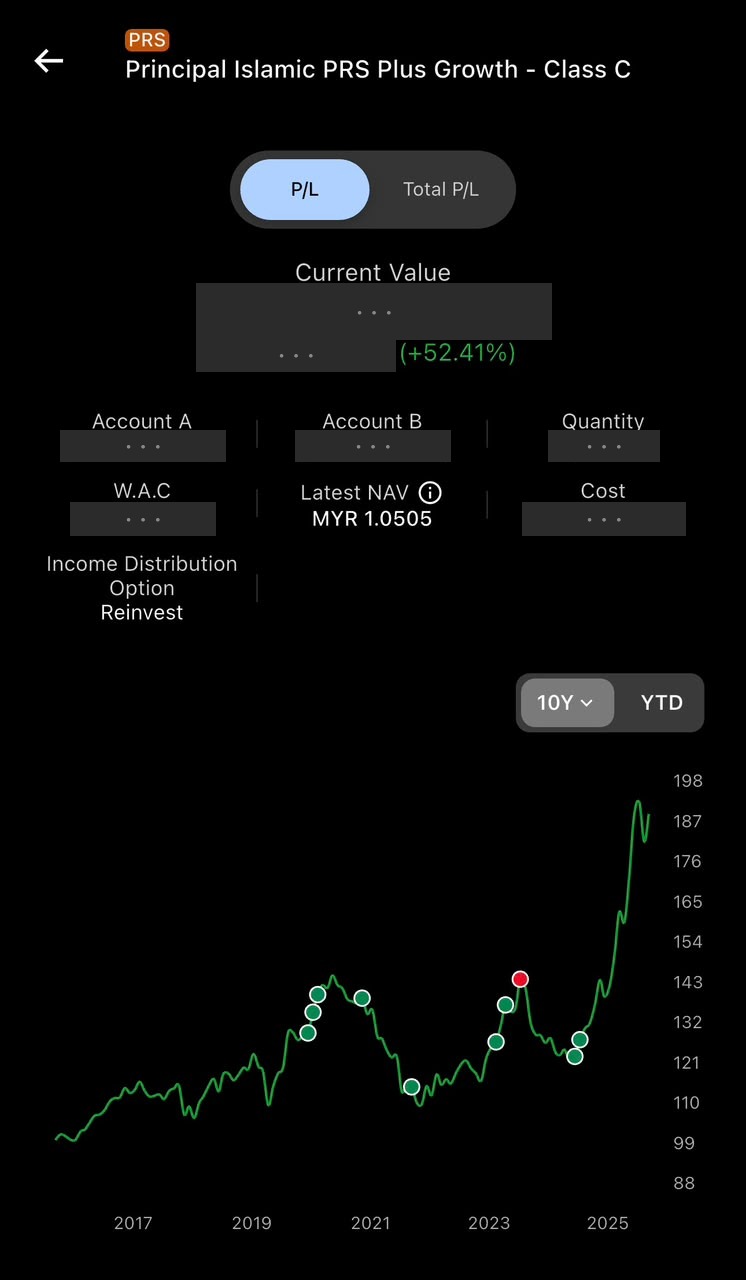
Gain against my average cost, as the app reports it — not an annualised return. Ringgit amounts — value, quantity and cost — are deliberately blacked out; the percentage is the part that's anyone's business.
The green dots are purchases made on schedule — through the 2020 crash, the ugly 2022 slide, the 2025 dip right before it ran — while the fund climbed from around 99 to nearly 190 and I mostly stayed out of my own way. Not because I timed anything. Because I refused to interfere.
The chart starts later than the account does. FSMOne only plots a ten-year window — that is the longest view the app offers — so the first couple of years of buying sit off the left edge of this picture.
The line tracks the fund's price only — it doesn't capture the distributions I reinvested along the way, so my actual total return over the decade was higher than the line alone shows. Past performance is never a guarantee of future results. Verify any figure yourself before you lean on it.
See the one red dot? That's the single time I moved money out — I switched a slice into a more conservative fund, taking a little risk off the table. Inside the PRS wrapper, moving between funds costs nothing, so it was a deliberate step down in risk, not a panic. But it's the honest exception to "do nothing," and I'm leaving it on the chart instead of cropping it out. Because that's the whole discipline in one picture: the core keeps compounding, and the few times I touched it, I kept it small.
The losing had taught me the satellite half — the small, honest edge you're allowed to be wrong with. This boring little account, it turned out, had been quietly teaching me the core half the whole time.
Bogle left me one last gift: he showed me where I'd been leaking money. A PRS wrapping index funds means paying two layers of fee — the scheme sitting on top of the funds underneath. That's what eventually pushed me to buy my core directly and get slightly obsessive about costs. But the lesson at the centre — own the index, keep buying, stay the course — I'd had right from the very start, without knowing it had an author.
Sources
Holdings, regional allocation and fee figures: Principal Islamic PRS Plus Growth – Class C fund fact sheet, 31 July 2026, published by Principal Asset Management Berhad — principal.com.my. Management fee 1.50% p.a. plus trustee fee 0.04% p.a. of NAV; fund inception 12 November 2012. Personal return and chart: screenshot of the author's own account, ringgit amounts redacted. Fund facts change — check the current fact sheet before relying on any figure here.
The necessary fine print. I'm not a licensed financial advisor under the Securities Commission Malaysia, and nothing here is personal advice or a recommendation to buy or sell anything. This is education — one person's hard-won thinking, shared openly. No ads, no paid sponsorships — nobody pays me to feature anything, and no recommendation is ever bought. The only links that earn me anything are the clearly-labelled referral links on the Toolkit page, for tools I personally use — and they usually hand you a bonus too. No sign-up needed to read. Always verify the numbers yourself before you act.
New here? The fastest way in is the free Starter Pack — five rules and two funds on one page. Want the full reasoning? Start with the core thesis.