5 things to take away
What the fee actually does
Two fees — only one is honest
The sales charge announces itself and leaves. The expense ratio says nothing, comes back every year, and is designed to be unfelt. The second one is the one that counts.
It charges your whole balance
Unlike a one-time entry fee, the expense ratio charges a percentage of everything you own — original money and every ringgit of growth it has earned. It taxes your success.
The gap is RM1,440 a year on RM100k
A 1.59% Malaysian Shariah fund vs an all-world ETF core at 0.15% (FWRA — the fund I actually compared mine against). The 1.44% annual gap on RM100,000 is RM1,440 silently leaving — every year, no notification, no line item.
The fee is certain; the outperformance is a hope
SPIVA data: over 15 years, the majority of active funds in every category underperform their benchmark. You pay the fee guaranteed. The beat is maybe. The house edge runs against you.
A higher fee can be worth it — but only if you know you're paying it
Shariah compliance, a genuine satellite, a smaller fund universe — these are honest reasons. Paying up by accident, because the entry was free, is not a reason. It's a leak.
The mistake
I felt clever about the wrong fee
When I bought into one of the Malaysian funds I still hold — a Shariah equity fund, focused on Bursa names — the thing I was proud of was the entry. On FSMOne, the sales charge on most unit trusts is waived to zero. So I paid nothing to get in. No RM50 here, no RM30 there. Free entry. I remember the small, stupid satisfaction of it, like I'd dodged something.
What I never did — not once, not for a long time — was ask the other question. The boring one. Okay, free to get in. But what does it cost me every single year just to keep holding this thing?
Because that fund's headline sales charge, the one I was so pleased to escape, is 1.50%. And the fee I never thought about — the annual one, the silent one — is 1.59% per year. Higher than the entry charge I'd been congratulating myself for avoiding. And unlike the entry charge, it comes back. Every year. For as long as I own the fund. And I would never, ever feel it leave.
That's the fee this chapter is about. The one you don't feel.
The two fees
Two fees — and only one of them is honest about itself
Every fund you'll ever buy — unit trust or ETF — charges you in two completely different ways, and they don't behave the same at all.
The first is the loud fee. The sales charge on a unit trust. The brokerage on an ETF trade. You see it happen. RM16 leaves your account, you watch it go, maybe you wince a little. It's a one-time goodbye. Pay it once and it's done.
The second is the quiet fee. The expense ratio. On an ETF it's called the TER (Total Expense Ratio). On a Malaysian unit trust it shows up as the Annual Expense Ratio (AER). Same idea, different label. This is the fee the fund house charges you for running the fund — paying the manager, the trustee, the admin, the index licence, all of it.
And here's the whole trick of it: you never see this one happen. It isn't a line item. Nothing leaves your account. No notification. No wince. The fund simply shaves it off the value of your units, a tiny sliver every single day, before it ever shows you a price. By the time you check your balance, the fee has already been taken — invisibly, baked into a number that looks like the market just did that to you.
The loud fee announces itself and then it's gone. The quiet fee says nothing and never leaves. Guess which one actually decides your outcome.
Sales charge / brokerage
Visible. One-time. You feel it leave. Charged only on what you put in. Once paid, it never comes back.
Expense ratio (TER / AER)
Invisible. Annual. You never feel it leave. Charged on your whole balance — original money and every ringgit of growth. Comes back every year, forever.
The silent fee
Why the silent one is the dangerous one
Think about what the quiet fee actually charges against.
The sales charge is a one-time bite out of the money you put in. Painful, but bounded — you can only pay it once, on what you contributed.
The expense ratio is charged every year on everything you've got — your original money and every ringgit of growth it has ever earned. It's a tax on your accumulated wealth, not just your contributions. And the longer you compound, the bigger the pile it's skimming from. The fee doesn't shrink as you succeed. It grows with your success, because your balance is what it feeds on.
The market's return is uncertain — it could be +20% or −30% next year, nobody knows. But the fee is certain. A 1.59% AER means you start every year already down 1.59%, locked in, before a single stock moves.
You cannot control what the market gives you. You can control how much of it you hand back. The expense ratio is the one number in your whole investing life that is both completely knowable in advance and completely within your control. Almost nothing else qualifies.
The receipts
My two funds, side by side
Both funds happen to be ones I hold. I'm not recommending either — this is to put an actual number on what a fee gap costs, on real figures, over real time.
The core thesis now points to VWRA as the simplest default, since Vanguard cut its fee to 0.14% in July 2026. This page still measures against FWRA at 0.15% for one reason: it's the fund I actually held my expensive one against, so the numbers below are a real comparison rather than a constructed one. The 0.01% difference changes nothing about the argument — if anything it understates it. Against VWRA the annual gap is 1.45% rather than 1.44%, and the RM1,440 below becomes RM1,450.
| Malaysian Shariah equity fund | FWRA (all-world core) | |
|---|---|---|
| Annual expense ratio | 1.59% AER (as at 31 Dec 2025) | 0.15% TER |
| What's inside it | Mgmt fee 1.50% + trustee 0.09% | All-in fund running costs |
| On RM1,000 held | ~RM15.90 / year | ~RM1.50 / year |
These two funds are not doing the same job. One is a concentrated bet on Malaysian companies, run by a human manager. The other is a rules-based machine owning the whole investable world. Different exposures, different risk, different purpose. I'm isolating one variable — cost — and holding everything else still so we can actually see the fee.
The 30-year cost of the gap
Same RM1,000 in. Identical assumed 7% gross return (a made-up number, chosen only to strip out everything except cost — not a forecast). The only difference is the expense ratio.
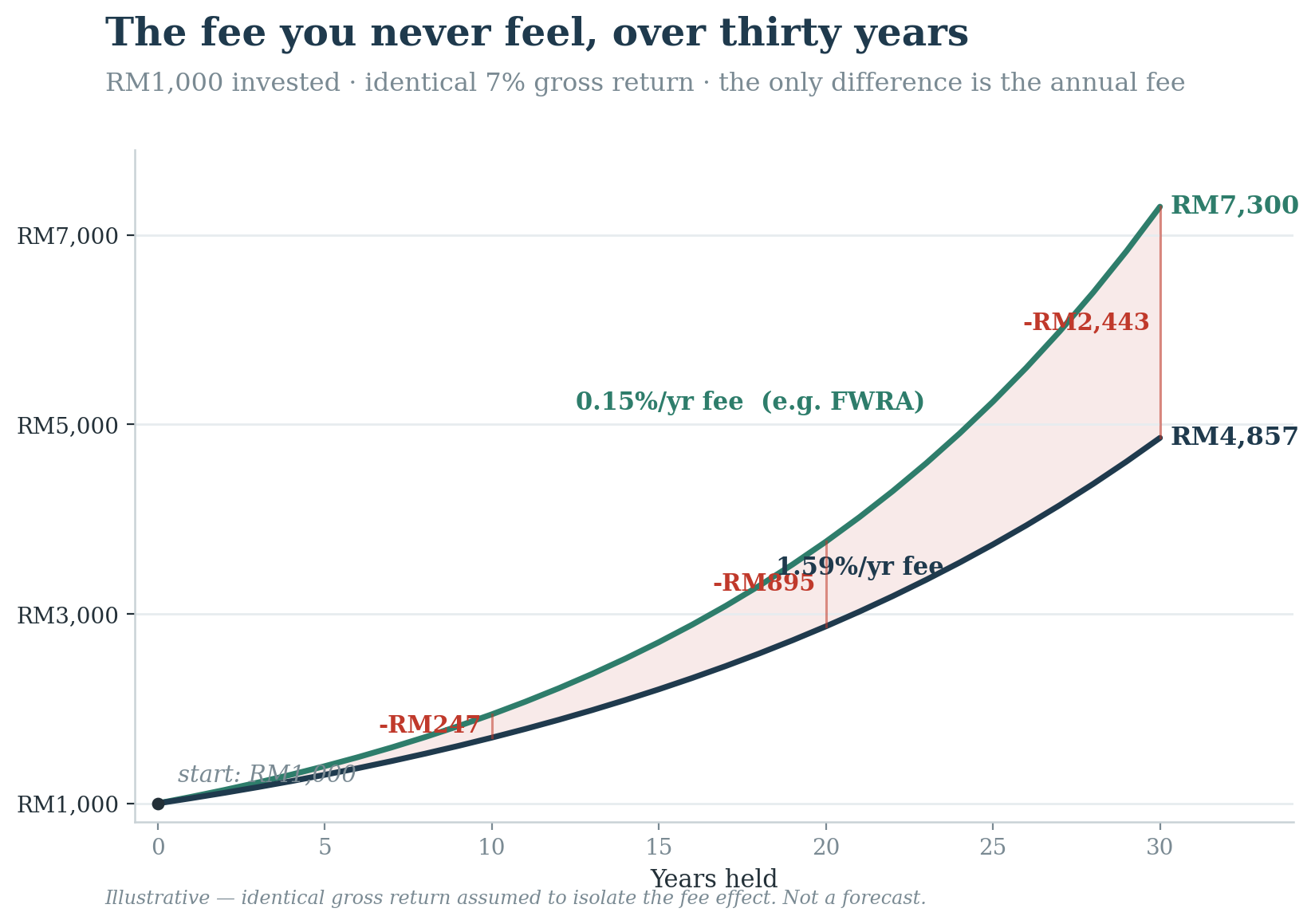
Illustrative — identical gross return assumed to isolate the fee effect. Not a forecast.
| Held for | At 1.59% AER → net 5.41% | At 0.15% TER → net 6.85% | Lost purely to the fee gap |
|---|---|---|---|
| 10 years | ~RM1,693 | ~RM1,940 | ~RM247 |
| 20 years | ~RM2,868 | ~RM3,763 | ~RM895 |
| 30 years | ~RM4,857 | ~RM7,300 | ~RM2,443 |
RM1,000 is a toy example. Run it on a real balance. Say you've built up RM100,000:
RM1,590 / year
Silently skimmed off your balance — before you see the price, before a notification, before anything. Gone, every year.
RM150 / year
The whole-world index, 48 markets, ~4,250 stocks. Running costs: one and a half hundred ringgit annually.
RM1,440 / year
A decent phone, gone annually, every year, without a single transaction you can point to. This is the fee that decided your outcome.
The active-fund case
"But the active fund might beat the market"
This is the honest counter-argument, and it deserves a straight answer instead of a sneer.
The pitch for paying 1.59% is: you're not buying a machine, you're buying a manager. A skilled human who picks the winners, dodges the losers, and earns back that fee — and then some — by beating the market the cheap index fund only matches. If that's true, the higher fee is a bargain.
Sometimes it is true. In a single year. For a particular manager. The problem is what happens when you stretch the timeline out to the length you actually invest over — decades, not quarters.
S&P keeps the scoreboard on this, in a long-running study called SPIVA. Their year-end 2025 results are blunt:
Closer to home: SPIVA's Asia ex-Japan scorecard — which covers Malaysia — found a majority of active funds underperformed their benchmarks across domestic equity, international equity, and bonds, with underperformance again widening over longer horizons.
The fee is certain. The outperformance is a hope.
You pay the 1.59% guaranteed, up front, every year, no matter what. The market-beating return that's supposed to pay for it is a maybe — and a maybe the long-run data says usually doesn't show up. You're paying a sure cost for an unsure benefit, and the house edge runs against you the longer you stay.
That's not a reason active management can never be worth it. It's a reason the bar should be very high before you pay up.
The connection
The part that connects to everything else
There's one more reason fees bite harder than they look, and it ties back to the rest of how I invest.
More than half of the long-run total return from the stock market, historically, doesn't come from share prices going up — it comes from dividends being reinvested and compounding. That reinvestment is the quiet engine underneath everything.
Now notice what an expense ratio actually eats. It doesn't politely take its cut only from your gains. It takes a slice of your whole balance — which means it's shaving the very base that your dividends are trying to compound on top of.
A high fee doesn't just cost you the fee. It shrinks the engine. Every ringgit skimmed is a ringgit that never gets to reinvest and snowball. On a multi-decade hold, that's the difference between a fund that builds wealth and one that merely keeps pace while the manager builds theirs.
This is also why the choice of accumulating vs distributing matters so much. An accumulating fund like VWRA or FWRA reinvests dividends automatically inside the fund at no cost — the full dividend goes straight back into work. A distributing fund pays cash into your account, which you then have to manually reinvest, after potentially paying brokerage again. (Worth noting for halal investors: the ISDW + ISDE pair is distributing, so you reinvest the cash yourself — a small friction, not a dealbreaker.) The expense ratio and the accumulating structure are two sides of the same coin: both keep more of the engine running.
When fees are worth it
When a higher TER is honestly worth paying
I don't want to leave you thinking low fee = good, high fee = bad, full stop. That's lazy, and it's wrong. There are real reasons to pay more, and I pay more in a few places myself — knowingly.
- You're buying an exposure you genuinely can't get cheaper. A halal all-world core, for instance, costs more — the practical ISDW + ISDE pair runs ~0.30% + ~0.35% (and the one-ticker MWIM, 0.35%), versus ~0.14–0.15% for a conventional tracker — because the screening and smaller scale cost money. If a halal mandate is non-negotiable for you, that premium isn't waste; it's the price of the thing you actually need. (Full comparison on the halal all-world page.)
- It's a deliberate satellite, not your core. A thematic or actively-run slice you've chosen with eyes open, sized small, where you've decided the specific exposure justifies the drag.
- You've honestly weighed it against the index alternative and decided the trade-off is yours to make.
What's not okay is paying a high fee by accident — because you never checked, because the entry was free so you assumed the holding was cheap, because the number was invisible so you never went looking. Which was me. The crime isn't paying 1.59%. The crime is paying it for years without ever knowing you were.
Practical
How to actually find the number — and not get fooled
Three things, learned the slow way:
Find the all-in number, not just the management fee
On a Malaysian unit trust, the figure you want is the Annual Expense Ratio (AER) — it bundles the management fee, the trustee fee, and the rest into one honest total. On FSMOne it's in the fund's "Fees" tab. For an ETF, it's the TER, on the factsheet. Don't anchor on the management fee alone; it's always smaller than the real cost.
Don't let a waived entry fee blind you to the holding cost
This was my whole mistake. "0% sales charge" feels like "free," and that feeling switches your brain off before it asks about the annual fee — which is usually the bigger number anyway. Free to enter says nothing about cheap to own.
Compare like with like
A 1.59% Malaysian active equity fund and a 0.15% global index ETF aren't competing for the same slot. The question isn't "which fee is lower" in the abstract — it's "for this job in my portfolio, am I paying a fair price, and do I know why?"
The verdict
The loudest fee is the one that never makes a sound
I held a fund for a long time and never knew what it cost me, because the cost was designed to be unfelt. That's the lesson, and it's almost embarrassingly simple:
Over thirty years, a 1.44% gap isn't a rounding error. It's a chunk of your retirement, handed over a sliver at a time, in transactions you never see.
I gave up nothing to lower my fees except a feeling — the feeling that the expensive fund, run by a clever human, must surely be doing something the cheap one couldn't. The data quietly disagreed. And the money I stopped handing over every year is now compounding for me instead of for a fund house.
The loudest fee you'll ever pay is the one that never makes a sound.
Next, in Part 2
Reading the Real Price Tag
Now that you know why the expense ratio matters, the practical half: how to read the fee tab of any fund on FSMOne — sukuk, active equity, or ETF — and know in thirty seconds exactly what it'll cost you. Because it turns out the funds don't even charge you the same way.
Read Part 2 →Quick reference
Expense ratio at a glance
| Question | Answer |
|---|---|
| What is it? | Annual % a fund charges to run itself — TER (ETFs) / AER (Malaysian unit trusts) |
| How is it charged? | Skimmed off the fund's value daily, invisibly — never a line item you see |
| What does it charge against? | Your whole balance, every year — original money + all gains |
| Why does it matter long-term? | It compounds against you; the longer you hold, the more it takes |
| The funds in this chapter | Malaysian Shariah equity fund: 1.59% AER · FWRA: 0.15% TER (VWRA, the other all-world default, is now even cheaper at 0.14% — the gap only widens.) |
| Annual cost on RM100k | ~RM1,590/yr vs ~RM150/yr → ~RM1,440/yr gap |
| Fee gap on RM1,000 over 30 yrs* | ~RM2,443 lost to cost alone |
| When is a higher TER okay? | Deliberately — for an exposure you can't get cheaper (e.g. Shariah core) or a chosen satellite, eyes open |
| Where to find it | Unit trust → FSMOne "Fees" tab (AER line) · ETF → fund factsheet (TER) |
*Illustrative — identical 7% gross return assumed to isolate fee effect. Not a forecast.